Vulnerability Assessment, Penetration Testing & Red Teaming— Why All Three Matter for Your Business
The Security Illusion: “We Have Tools, We’re Safe”
You’ve invested in a firewall. You have a WAF protecting your web apps. Your endpoints run EDR. Your SOC team has XDR dashboards glowing green. Leadership feels confident. But here’s a question worth asking — have you ever tested whether any of that actually works against a real attacker?
Think of it like your home’s fire safety. You have smoke alarms, a fire extinguisher, and a sprinkler system. But have you ever tested whether the alarm triggers correctly, whether the extinguisher is charged, or whether the sprinkler valve is actually open? Having the tools isn’t the same as knowing they work. Security is no different.
This is exactly where Vulnerability Assessment (VA), Penetration Testing (PT), and Red Teaming come in — not as replacements for your tools, but as the tests that prove whether they actually protect you.
The Three Layers: What Each One Does
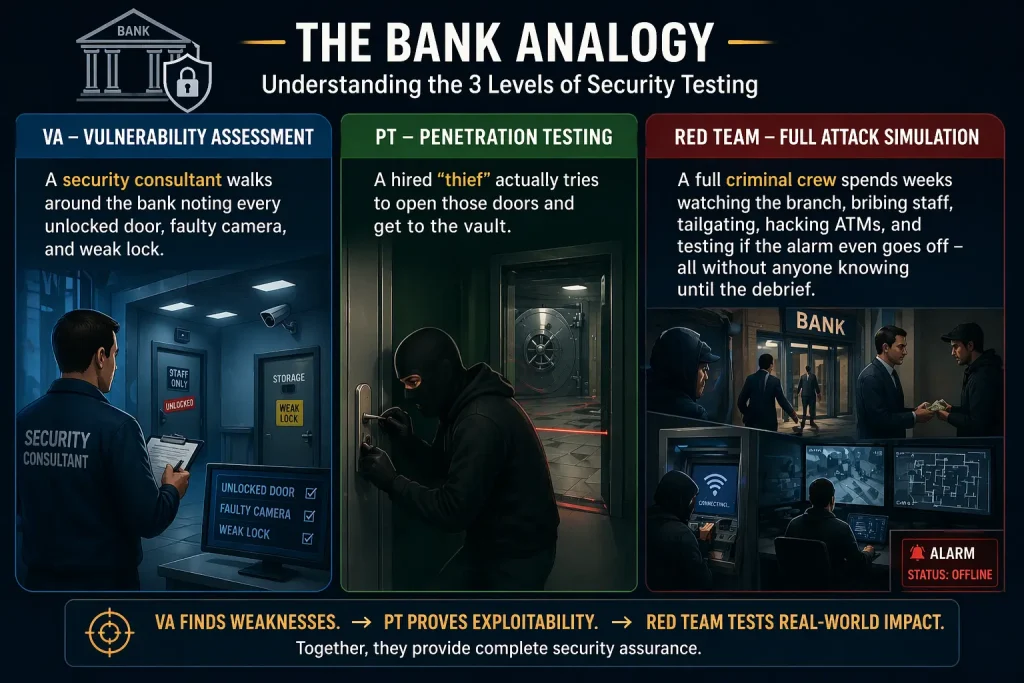
To make this easy to understand, let’s walk through a bank branch analogy.
Layer 1 – Vulnerability Assessment (VA)
Finds what’s unlocked or broken — without touching anything.
- Automated + manual scanning
- Lists all security weaknesses
- No exploitation — just discovery
- Risk-rated report (Critical/High/Medium)
- Fast, periodic, cost-effective
Layer 2 – Penetration Testing (PT)
Actually tries to break in — with permission — to see what’s exploitable.
- Manual, skilled ethical hacking
- Confirms if vulnerabilities are real risks
- Tests specific systems or apps
- Shows what an attacker could access
- Scoped, time-bound engagement
Layer 3 – Red Teaming
Simulates a full, real-world adversary campaign against your entire organisation.
- Adversary simulation (APT-style)
- Tests people + processes + technology
- Phishing, social engineering, physical access
- Long-duration, stealth operation
- Tests your detection & response (Blue Team)
“We Did a VA — Why Do We Still Need Pen Testing?”
This is the most common question we hear. Here’s the truth: VA tells you the door might be weak. PT tells you someone can actually kick it open and walk to the safe.
VA finds: “Port 8080 is open. Apache 2.4.49 is running — known CVE exists.”
This is important information — but it doesn’t confirm exploitability in your specific environment, with your specific configuration and compensating controls.
PT confirms: “Yes, that CVE is exploitable. We gained RCE and accessed your customer database.”
Now you know the actual business impact — not just a theoretical risk score. You can prioritise remediation with full context. Without PT, you might deprioritise a critical finding because it “looked low-risk on paper.”
“A VA without a PT is like a doctor listing all your possible diseases without running a single diagnostic test. The list might look alarming — or reassuring — but you still don’t actually know what’s wrong.”
“We Do VA + PT Both — Why Would We Need Red Teaming?”
VA and PT test your defences in isolation — individual systems, applications, or networks. Red Teaming tests your entire organisation as a system, including the humans inside it.
VA + PT are announced (usually)
Your IT team knows testing is happening. Real attackers don’t send calendars invites. Red Team operates in total stealth — just like a real threat actor would.
Attack chains are tested
A single finding may be “low risk” alone, but chaining 5 low-risk findings together can lead to complete system compromise. Red Teams find these chains. VA/PT rarely do.
People are the weakest link
Red Teams test phishing, vishing (phone calls), pretexting, and even physical entry. 91% of breaches begin with human error — yet VA and PT rarely test this.
Tests your detection + response
Does your SOC detect lateral movement in real time? Red Teaming validates whether your six-figure SIEM investment truly works — or silently fails while attackers move undetected.

But We Have WAF, Firewall, EDR & XDR — Aren’t We Covered?
Security tools are guards at the gate. But guards can be fooled, bypassed, misconfigured, or overwhelmed. No tool is perfect — and attackers study every tool you deploy to find the bypass.
WAF Bypass
WAFs block known attack signatures. Expert attackers encode payloads, use HTTP parameter pollution, or abuse allowed methods to bypass rules entirely. PT/Red Team tests these gaps.
Firewall Misconfiguration
Firewalls block ports — but a single misconfigured rule, a legacy exception, or an overlooked management interface can expose your entire internal network.
EDR Evasion
Modern threat actors use living-off-the-land (LotL) techniques — abusing legitimate tools like PowerShell, WMI, and certutil that EDR solutions often trust by default.
XDR Alert Fatigue
XDR generates alerts — but are they tuned correctly? Red Teaming reveals if your team can distinguish a real attack from noise, or if critical alerts get buried.
What Happens If You Don’t Test?
Real Business Impact.
Financial Loss
The average cost of a data breach is $4.88M globally. For many mid-market companies, ransomware and recovery costs can be business-ending.
Regulatory Penalties
SEBI, RBI, CERT-In, GDPR, and PCI-DSS all require periodic security testing. Non-compliance = fines, licence risks, and audit failures.
Reputation Damage
One publicised breach can eliminate years of customer trust — especially for BFSI, healthcare, and e-commerce brands where trust is the product.
Business Disruption
Ransomware can halt operations for days or weeks. Supply chain attacks can take down your partners. Downtime = direct revenue loss.
Legal Liability
If customer data is breached and you cannot demonstrate “due diligence” in security testing, you face personal liability as a CIO/CISO under Indian IT law.
IP & Data Theft
Intellectual property, trade secrets, and customer data stolen silently — often months before detection. Average dwell time: 194 days.
The Right Approach: A Layered Testing Strategy
Start with Vulnerability Assessment — Quarterly or after major changes
Get a full picture of your attack surface. Use this to maintain hygiene, track regressions, and meet compliance baselines. Every web app, portal, API, and network segment should be in scope.
Follow with Penetration Testing — At minimum annually, or before/after major releases
Target your critical assets: web apps, customer portals, APIs, internal networks, mobile apps. Prioritise systems that handle payments, PII, or privileged access. Demand manual testing, not just automated scans relabelled as PT.
Move Beyond Testing — Adopt Annual Red Teaming for High-Risk Environments
Once your VA and PT findings are remediated, test your complete defence ecosystem. Red Teaming is especially critical for BFSI, healthcare, critical infrastructure, and organisations with sensitive data at scale. It’s the final exam — and the results will surprise you.
What This Means for the CIO, CTO & CISO Specifically
Protect operational continuity & third-party trust
Security failures disrupt IT operations, damage vendor relationships, and derail digital transformation initiatives. Testing proves your programme is real — not just on paper. Board and investors increasingly demand evidence of security assurance, not just policy documents.
Secure what you build before attackers find it
Every API, web app, and microservice you deploy is an attack surface. PT and VA integrated into your SDLC (shift-left security) means vulnerabilities are caught before production — not after a breach makes the news. Red Teaming validates your architecture decisions at scale.
Turn “we think we’re secure” into “we’ve proven it”
You can’t defend what you don’t know is broken. These three layers give you the evidence to brief the board confidently, meet CERT-In and regulatory mandates, justify your security budget, and demonstrate due diligence. When a breach inquiry happens, “we tested regularly” is your most important defence.
How Access0day Can Help
Access0day — Real Expertise. Real Testing. Real Assurance.
India-based offensive security experts helping organisations find weaknesses before attackers do.
At Access0day, we don’t run automated scans and call it a pentest. Our team brings hands-on offensive security expertise across web applications, network infrastructure, cloud environments, and adversary simulation — backed by globally recognised certifications.
You’re in the hands of certified experts who don’t just assess security

Manual Testing vs Automated Tools — What Should You Choose?
This is where most organisations make a costly mistake. They pay for a “penetration test” and receive a report generated by an automated scanner — dressed up in a nice PDF. That is not a pentest. That is a VA report with a premium price tag. Here’s how to tell the difference, and why it matters for you.
Manual Testing
Human intelligence drives it. A tester thinks like an attacker — chaining vulnerabilities, testing edge cases, and exploring paths no scanner imagines.
Finds business logic flaws. “Can I change $100 to $1 at checkout?” — only a human catches this.
Real exploitation demonstrated. You see exactly what an attacker gets — files, credentials, admin access — not just a theoretical CVE score.
Zero false positives. Every finding is verified by a human. No noise, no wasted remediation hours chasing phantom issues.
Context-aware. Testers understand your application’s purpose and attack it intelligently — not just with generic payloads.
Required for compliance. CERT-In, PCI-DSS, RBI guidelines specifically require manual penetration testing — not just automated scans.
Automated Testing
Fast and cheap. Covers large surface areas quickly — excellent for maintaining hygiene and catch known CVEs across many systems.
High false positive rate. Automated tools regularly flag issues that are not actually exploitable in your environment — wasting your team’s time.
Signature-based detection only. Tools match known patterns. They cannot discover novel attack chains or zero-day-style logic abuse.
No contextual understanding. A scanner hitting your login page doesn’t know it’s a banking portal with 2 million users — it just fires payloads.
Misses authentication flaws. IDOR, broken access control, and privilege escalation — the most critical app-layer bugs — are largely invisible to scanners.
Cannot simulate social engineering. No tool can call your helpdesk pretending to be an employee. Humans are still the primary attack vector.
At Access0day, We use automated tools as a force multiplier — to ensure full coverage of your attack surface — but every critical finding is manually verified, manually exploited, and manually documented by certified experts. You get the speed of automation with the depth of human expertise. That combination is what separates a real security assessment from a scanner report with a logo on it.
Nature analogy: An automated scanner is like a metal detector on a beach — fast, covers ground, finds obvious items. A manual tester is the archaeologist who digs carefully, reads the soil, identifies what the metal detector flagged as “noise” but is actually a priceless artefact — or a dangerous unexploded device.
How AI Is Changing VAPT and Red Teaming — And What It Can’t Replace
Artificial intelligence is genuinely transforming the security testing landscape. But it is doing so as an accelerator for skilled humans — not as a replacement. Understanding the difference is critical before your organisation invests in “AI-powered security testing” products.
.
Should your organisation just buy an “AI-powered VAPT tool” and run it yourself?
This is becoming a common question as vendors market AI security products heavily to CISOs. The honest answer is: AI tools are useful for hygiene and continuous monitoring — but they cannot replace expert-led penetration testing. Here is why:
Human expert tester
Understands business context. Knows which data is crown jewels, which access path causes maximum damage, which finding matters most to your board.
Chains vulnerabilities creatively. Combines a misconfiguration, an IDOR, and a weak password policy into a full account takeover — the way a real attacker would.
Adapts in real-time. When a payload fails, a human thinks laterally. AI retries variations of the same approach.
Tests human behaviour. Social engineering, vishing, physical intrusion — these require human actors, not algorithms.
Accountable and certified. A human expert can testify, explain, and defend findings in a board meeting, regulatory audit, or legal proceeding.
AI tool alone
Pattern-matching only. Identifies known vulnerability signatures but cannot reason about novel attack paths or business-specific logic flaws.
No creative chaining. Finds individual issues but rarely connects them into an attack narrative that shows real-world breach impact.
High false positive rates. AI tools still generate noise — requiring human review to separate genuine risks from phantom findings.
Cannot test humans. The most dangerous attack vector — your people — is completely outside an AI tool’s reach.
No regulatory standing. Most compliance frameworks (CERT-In, PCI-DSS, RBI) require human-led penetration testing. An AI tool report does not satisfy these requirements.
The right model: AI as co-pilot, human expert as pilot. AI helps us go deeper and faster. It does not replace the thinking that finds what matters most to your business.
Why Access0day — Our Expertise, Your Advantage. We don’t just find vulnerabilities. We show you exactly what an attacker would do with them.
Access0day is an offensive security firm built by practitioners — ethical hackers, red teamers, and security researchers who have spent years on both sides of the attack surface. We bring that real-world attacker mindset to every engagement.
What makes Access0day different Approach
Manual-first methodology
We use automated tools for coverage. We use human expertise for depth. Every critical finding is manually verified and exploited — not just flagged by a scanner.
Real exploitation, not theory
We don’t stop at “this could be exploited.” We demonstrate the actual impact — showing you the data we accessed, the systems we controlled, the credentials we captured.
Domain-specialist teams
Web app security, network infrastructure, cloud environments, mobile applications, active directory — each engagement is led by specialists in that domain, not generalists.
Board-ready reporting
Our reports speak two languages — deep technical detail for your security team, and clear business-impact summaries for the CIO, CTO, CISO, and board. No translation needed.
AI-augmented testing
We integrate AI-powered recon, smart fuzzing, and threat intel correlation into our workflow — giving you the speed of automation with the depth of expert analysis.
Post-engagement support
We don’t disappear after delivery. We debrief your team, answer questions, and offer re-test validation once you’ve remediated findings — ensuring closure, not just a PDF.
Our certified experts — the people behind every engagement
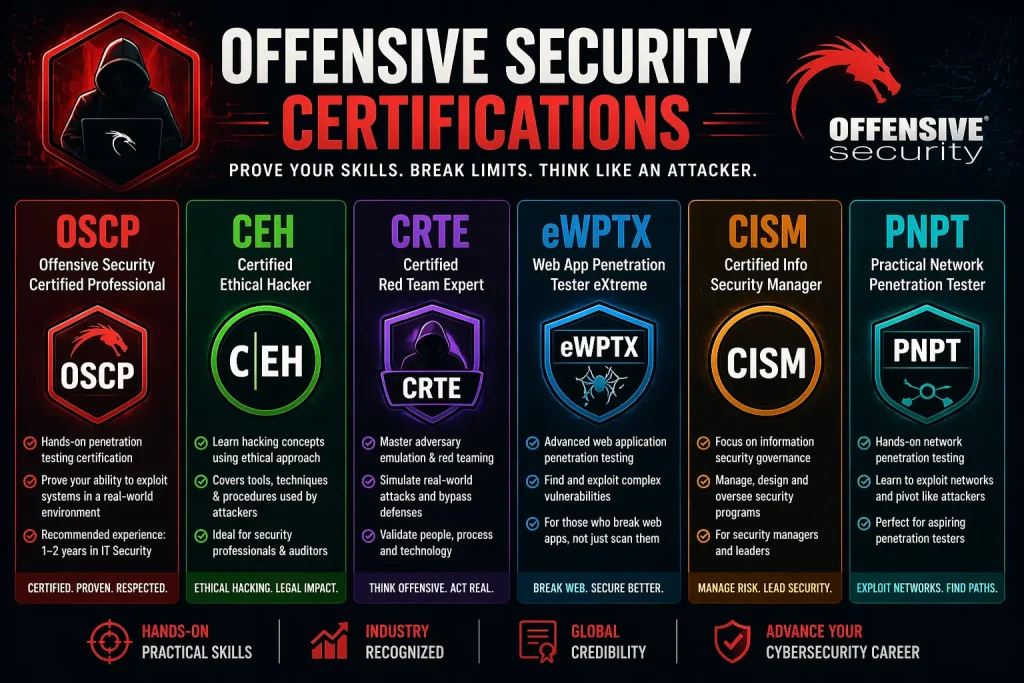
Our team holds the most respected offensive security certifications in the industry. These aren’t classroom certificates — they’re hands-on, exam-only credentials that require real exploitation under pressure.
OSCP OSEP CRTE CRTO CEH Master eWPTX eJPT PNPT CISM CISSP CompTIA PenTest
Ready to know where you actually stand?
Talk to the Access0day team — no obligation, no jargon. Just a clear conversation about your environment and what testing makes sense for you.
Don’t Just Identify Risks — Validate Them Against Real-World Attacks
VA – Finds the weakness
PT – Test/exploit the weakness
RED – Simulate the real attacks for complete organization
Do you have a complete oversight of your Security Posture?
Unlock Insights by Scheduling Your Comprehensive Discovery Call Now