The CIO & CISO Guide to Cybersecurity Frameworks: From Compliance to True Resilience
Frameworks are maps, not journeys. A map tells you what the terrain looks like. It doesn’t walk the road for you, and it doesn’t guarantee you won’t fall into a ditch.
Every CIO and CISO knows the pressure: auditors want evidence, boards want assurance, customers want certifications. The result is organisations that are audit-ready but not attack-ready — producing compliance artefacts at pace while their detection and recovery capabilities lag years behind.
This guide cuts through the alphabet soup. It explains what each major framework actually covers, what it misses, where frameworks overlap, and how to use them together as a coherent security programme rather than a stack of separate checklists.
CICRA 2005 — Credit Information Companies (Regulation) Act
India’s RBI-enforced law governing how credit data (CIBIL scores, loan history) is collected, shared, and protected across the credit ecosystem.
Who it applies to:
Credit Information Companies — CIBIL, Equifax, Experian, CRIF High Mark
Data accuracy — lenders must submit correct, complete data to bureaus. Submitting wrong data is a punishable offence.
Purpose limitation — credit reports can only be used for the exact purpose they were pulled. Using a loan-application report for marketing is a violation.
Individual rights — any person can access their own credit report and dispute errors. CICs and lenders must resolve disputes within prescribed timelines.
Confidentiality — credit information cannot be disclosed to any unauthorised party under any circumstance.
What CISOs must own directly:
Access logs on every credit report pulled from a bureau
Validation controls on CIC data submission pipelines
Vendor contracts covering any system that touches credit data
A dual incident response runbook — CICRA breach triggers both RBI notification and DPDP Act notification simultaneously
Penalty: Fines up to ₹1 lakh per day of default. Directors personally liable. RBI can revoke bureau licences.
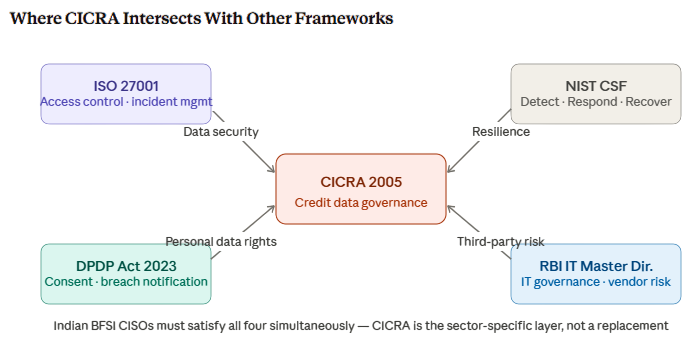
The critical overlap: CICRA, the DPDP Act 2023, and the RBI IT Master Direction (2023) all apply to the same credit data simultaneously. Satisfying one does not satisfy the others — all three stacks must be mapped together.
Think of CICRA as the pipeline inspector — it governs every joint between lenders, bureaus, and users, and ensures no data leaks, no misuse, and every individual can see what flows through about them.
ISO 27001:2022 — The Foundation of Information Security Management
ISO 27001 is an international standard for building and operating an Information Security Management System (ISMS). It is not a technical checklist. It is a management system standard — meaning it governs how you govern security, not just what technical tools you deploy.
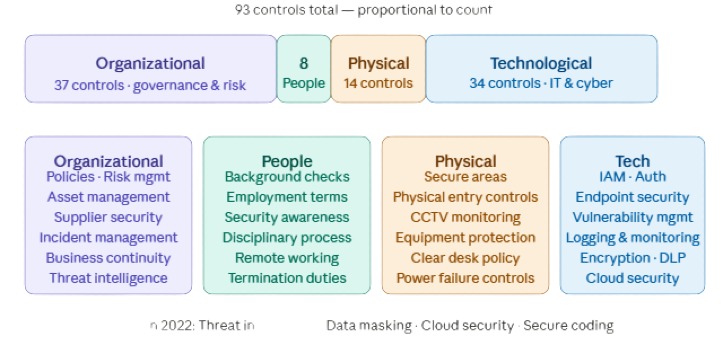
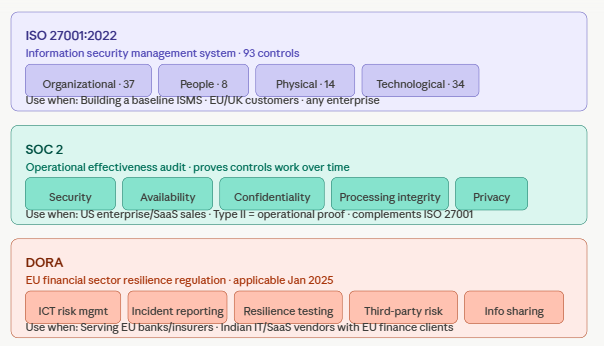
The 2022 revision introduced 93 security controls, reorganised from the 114 controls in the 2013 edition. The reduction is not a weakening — it reflects consolidation and the addition of controls specifically addressing cloud security, threat intelligence, and data masking, which the older standard did not address.
The four control categories
Think of the 93 controls as four concentric rings of protection, from the outermost governance layer to the innermost technology layer.
What ISO 27001 does well
It forces senior management ownership of security risk. The standard requires a documented risk treatment plan, an internal audit programme, and management review — meaning security cannot be siloed in IT. It gives auditors, customers, and regulators a universally recognised signal that your security management system has been independently validated.
What ISO 27001 does not do
It does not tell you whether your controls are working today. Certification is a point-in-time validation. An organisation can be ISO 27001 certified and breach the same week. The standard governs the management system, not operational effectiveness. That gap is exactly what SOC 2 is designed to fill.
Think of ISO 27001 as a wheel with four spokes — Organisational, People, Physical, Technological. The wheel only rolls if all four spokes are intact. Most organisations have strong Technological spokes and weak People spokes. That is where breaches happen.
SOC 2 — Proving Your Controls Actually Work
SOC 2 (Service Organisation Control 2) is an American auditing standard developed by the AICPA. While ISO 27001 certifies that you have a management system, SOC 2 certifies that your controls operated effectively over a defined period — typically six to twelve months.
The five Trust Service Criteria are:
Security — protection against unauthorised access
Availability — systems are available as committed
Confidentiality — information designated confidential is protected
Processing integrity — system processing is complete, accurate, and timely
Privacy — personal information is collected and used appropriately
Security is mandatory. The other four are chosen based on what your service promises to customers.
SOC 2 Type I vs Type II — the critical distinction
Type I: a point-in-time snapshot. “Your controls are designed appropriately.” Think of it as a building inspection that checks the fire exits exist.
Type II: an operational audit over six to twelve months. “Your controls operated effectively throughout the period.” This is the inspection that checks people actually used the fire exits during drills.
For enterprise sales and regulated industries, Type II is the meaningful credential. Type I is a starting point.
Do you need SOC 2 if you already have ISO 27001?
Not always — but increasingly, yes. The practical answer depends entirely on your customer base. US enterprise and SaaS buyers overwhelmingly ask for SOC 2 Type II. EU and UK enterprise buyers are more likely to accept ISO 27001. If you sell to both markets, you will eventually need both.
The two standards complement rather than duplicate each other. ISO 27001 builds the management system; SOC 2 proves the management system is functioning. Many controls map between the two, so the audit effort is lower if both are pursued together.
DORA — The EU’s Operational Resilience Mandate for Finance
The Digital Operational Resilience Act became fully applicable across the European Union in January 2025. It applies to banks, insurers, payment institutions, investment firms, and — critically — the ICT and cloud vendors that serve them.
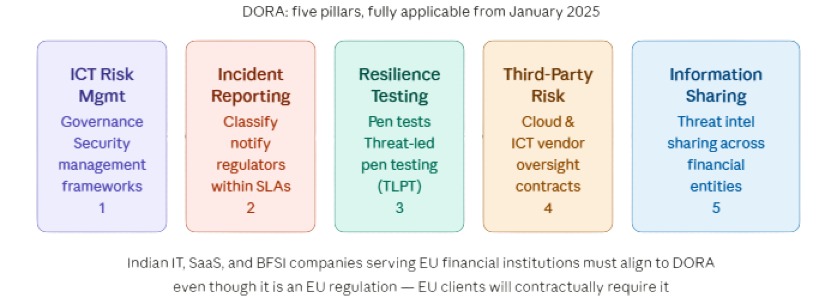
DORA does not use the language of “controls.” It is structured around five pillars, each governing a distinct aspect of how financial institutions manage digital risk.
What makes DORA different from everything else
DORA’s most disruptive element is Pillar 4: Third-Party Risk Management. It makes EU financial institutions legally responsible for the resilience of their cloud and ICT providers. This means contracts with EU banks will now include DORA-specific requirements for ICT vendors — including Indian IT service providers, SaaS companies, and offshore delivery centres.
DORA also introduces Threat-Led Penetration Testing (TLPT) — mandatory for significant financial entities. Unlike standard penetration tests, TLPT must use real, current threat intelligence relevant to the specific institution. It cannot be a recycled script.
Is DORA relevant to Indian organisations?
Directly, no. DORA is an EU regulation. But indirectly, it is becoming a material compliance requirement for any Indian organisation that serves EU financial clients — which covers a large portion of the Indian IT and BFSI services sector.
NIST CSF 2.0 — The Master Blueprint
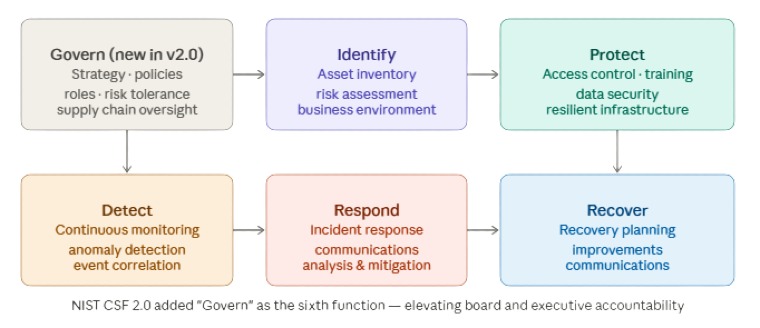
The NIST Cybersecurity Framework (now at version 2.0, released February 2024) is published by the US National Institute of Standards and Technology. It is voluntary, not regulatory — but it has become the de facto baseline for serious security programmes globally, including in India.
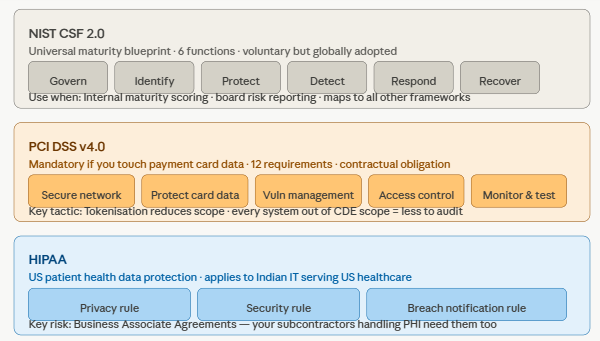
NIST CSF 2.0 expanded from five to six functions. Think of these as the six questions a mature security programme must answer continuously.
Why NIST matters for CIOs and CISOs
NIST CSF is the best framework for internal security maturity measurement. It gives you a language that boards, risk committees, and technical teams can all use. Each function maps to a maturity tier from Partial (Tier 1) to Adaptive (Tier 4).
The new Govern function in version 2.0 is significant for Indian enterprises. It explicitly frames cybersecurity as a board-level enterprise risk, not an IT department responsibility. This is the language Indian CISOs need when fighting for budget.
Think of NIST as a crime novel in six chapters. Govern is the detective agency’s policies. Identify is the crime scene — cataloguing what you have. Protect is the security system you install after the crime. Detect is the alarm that rings when someone breaks in anyway. Respond is the police arriving. Recover is rebuilding after the damage. A security programme is only as good as its weakest chapter.
PCI DSS v4.0 — Non-Negotiable if You Touch Payment Cards
The Payment Card Industry Data Security Standard is maintained by the PCI Security Standards Council, which represents Visa, Mastercard, Amex, Discover, and JCB. Unlike ISO 27001 or NIST, PCI DSS is not voluntary — if you store, process, or transmit cardholder data, compliance is contractually mandated by your payment processor.
Version 4.0, released in 2022 with mandatory compliance from April 2024, introduced a significant conceptual shift: organisations can now achieve compliance through a “customised approach,” where they demonstrate that their controls achieve the stated security objective even if the controls differ from the prescriptive standard.
PCI DSS has 12 requirements organised around six goals:
Build and maintain a secure network
Protect cardholder data
Maintain a vulnerability management programme
Implement strong access controls
Regularly monitor and test networks
Maintain an information security policy
The single most important concept in PCI DSS: scope reduction
The most powerful tool in PCI DSS compliance is reducing the scope of the Cardholder Data Environment (CDE). Every system that touches, stores, or could affect cardholder data is in scope and must meet all 12 requirements. Every system outside scope is excluded from PCI assessment.
The practical implication: tokenisation and point-to-point encryption are not just security tools — they are scope reduction tools. A payment architecture that tokenises cardholder data before it enters your systems can dramatically reduce your PCI DSS surface area and your compliance cost.
Think of PCI DSS as the rules for running a bank vault. The 12 requirements describe how thick the walls must be, who gets a key, how you log every entry, and how often you test the alarm. Scope reduction means deciding how small to build the vault — because every square metre of vault costs money to protect. Tokenisation is outsourcing the vault entirely.
HIPAA — Healthcare’s Non-Negotiable Privacy Standard
The Health Insurance Portability and Accountability Act applies to US healthcare entities and their business associates. For Indian organisations, HIPAA becomes relevant when providing IT services, data analytics, or cloud hosting to US healthcare providers, insurers, or healthcare IT companies.
HIPAA organises requirements into three rules:
The Privacy Rule governs how Protected Health Information (PHI) may be used and disclosed. The Security Rule mandates specific administrative, physical, and technical safeguards for electronic PHI. The Breach Notification Rule requires covered entities to notify affected individuals, the Department of Health and Human Services, and in some cases the media when a PHI breach occurs.
The Security Rule distinguishes between “required” and “addressable” safeguards — but “addressable” does not mean optional. It means you must either implement the safeguard or document why an equivalent alternative achieves the same protection.
The concept that trips most IT organisations: Business Associate Agreements
If you are an Indian IT company providing services to a US healthcare entity and your services involve accessing PHI, you are a Business Associate under HIPAA. You must sign a Business Associate Agreement (BAA) and comply with HIPAA’s Security Rule in full. Your downstream subcontractors who touch PHI also become Business Associates and need their own BAAs.
This creates a chain of liability that many IT organisations do not appreciate until they are mid-contract negotiation.
Think of HIPAA as the rules for running a hospital’s patient records room. The Privacy Rule says who is allowed to read the files and under what circumstances. The Security Rule says how the room must be locked, who gets a key, and how you track who enters. The Breach Notification Rule says who you call when someone breaks in and takes files. Being a Business Associate means you are the off-site records storage company — you get the same rules even though you are not the hospital.
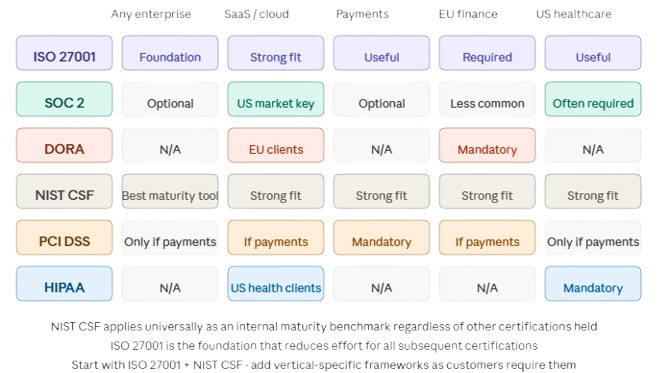
How All Six Frameworks Relate — The Master Map
This is the view your board needs when asking “which frameworks do we actually need?”
The CISO’s Framework Selection Checklist
Use this sequence of questions to determine which frameworks your organisation needs:
Question 1: Do you handle any sensitive data at all? → If yes, ISO 27001 + NIST CSF are your baseline. Build these first. Everything else sits on top.
Question 2: Do you sell to US enterprise or SaaS customers? → Add SOC 2 Type II. Type I to start; Type II within 12 months.
Question 3: Do you store, process, or transmit payment card data? → PCI DSS is non-negotiable. Scope reduction is your first engineering priority.
Question 4: Do you provide IT, cloud, or data services to EU financial institutions? → DORA alignment is required by your clients even if not directly by law. Review your contracts now.
Question 5: Do you handle US patient health information or support US healthcare organisations? → HIPAA applies. Review all subcontracting relationships for Business Associate Agreement coverage.
What the Board Should Actually Be Asking
The board’s job is not to understand the controls. The board’s job is to understand the risk. These are the questions that distinguish a security-literate board from a compliance-reporting board:
Instead of “Are we ISO 27001 certified?” ask “What is our current threat exposure and how has it changed since last quarter?”
Instead of “Have we passed the audit?” ask “What is our tested recovery time for a ransomware event against our three most critical systems?”
Instead of “What did the penetration test find?” ask “When did we last test an incident response scenario with the business continuity team, and what did we learn?”
Instead of “Are our suppliers compliant?” ask “Which of our critical suppliers have we verified can actually recover from a major incident without taking us down with them?”
Frameworks give you a vocabulary. Resilience gives you the outcome. The goal of every framework programme is to close the gap between the two.
Conclusion: Frameworks as a Journey, Not a Destination
Certification is a milestone, not an endpoint. The organisations that are genuinely secure treat frameworks as living programmes — continuously tested, continuously updated, and continuously connected to real threat intelligence rather than last year’s audit findings.
The progression for most Indian enterprises looks like this: ISO 27001 as the foundation, NIST CSF as the maturity measurement tool, then SOC 2 or DORA or PCI DSS or HIPAA added as specific customer relationships demand them.
The single most important shift any CIO or CISO can make is moving the internal conversation from “are we compliant?” to “have we tested our recovery?” Compliance is table stakes. Resilience is the game.
Quick Reference
CIO & CISO Leadership Series
The Security Leader’s Thinking Playbook
Four real conversations for security and business leaders — plain language, honest answers, structured thinking.
Session 01
Cyber Resilience vs Compliance — Passing Audits Is Not the Same as Surviving Attacks
Business Impact
Audits verify paperwork — they do not fire real bullets. Organisations that train only for audits are surprised when an actual breach moves faster and hits harder than any checklist anticipated. The cost of a real breach is measured in crores; the cost of being audit-ready is measured in hours. The two are not the same investment.
Implementation Excellence
Run a live attack simulation once a year where a hired team tries to break in exactly as a criminal would. When that report lands alongside your audit certificate, you can see the gap clearly — what the auditor validated and what the attacker exploited. That gap is where your real security budget should go.
Leadership Vision
The right question to ask in a leadership review is not “did we pass?” but “if we were breached at midnight tonight, how many hours before we know, and how many days before operations are fully restored?” Framing security conversations around recovery speed changes every budget conversation that follows.
Governance Effectiveness
Mature governance treats compliance as the starting line, not the finish line. The board should receive two separate scores each quarter: the compliance score from the auditor and the resilience score from simulated attack outcomes. Presenting only one of them is an incomplete picture that leads to underinvestment in real protection.
Challenge — Compliance culture rewards documentation over real readinessFix — Present attack simulation results at the same board meeting as audit outcomes
Business Impact
A CFO who cannot get a financial range for cyber risk cannot make informed investment decisions. When security leaders answer in technical jargon instead of rupees, they lose credibility at the table. The business impact of poor quantification is not just bad budgeting — it is leadership isolation that weakens every future security proposal.
Implementation Excellence
Pick your two most critical business processes — payment processing, customer data, supply chain — and model one realistic failure scenario for each. Estimate revenue lost per hour of downtime, regulatory penalty exposure, and recovery cost. That three-number model gives the CFO a financial range, not a technical opinion, and it changes the quality of every budget conversation.
Leadership Vision
Security leaders who speak financial language earn a seat at business strategy discussions. Those who remain in technical language stay in a budget-approval queue. The shift is deliberate: learn what the company values in rupees, then express every security investment as protection of that value. This repositions security from a cost centre to a business protection function.
Governance Effectiveness
Good governance requires that every significant security risk is documented with a financial exposure range — even a rough one. A risk register that lists threats without rupee values gives the board nothing to prioritise. A risk register with financial exposure turns security governance into a business management discipline, not a compliance exercise.
Challenge — Security teams think in vulnerabilities; boards think in financial exposureFix — Assign an INR range to each top-five risk before presenting to the board
Business Impact
Regulations are written after breaches happen, not before. The RBI or SEBI circular you comply with today was likely written in response to incidents from two to three years ago. Attackers read no such circular. Organisations that rely solely on regulatory guidance are perpetually responding to yesterday’s threats while tomorrow’s attacks are already in motion.
Implementation Excellence
Subscribe to sector-specific threat intelligence — CERT-In advisories, your industry’s Information Sharing and Analysis Centre, and threat reports from your primary security vendors. Assign one person to read these weekly and summarise the three highest-relevance findings for your environment. This takes two hours a week and consistently surfaces threats that no audit will ever find.
Leadership Vision
A proactive security leader runs a quarterly “beyond compliance” review — a structured session that asks what new attack techniques have appeared in the last 90 days that no regulation yet covers, and what the organisation would do if that technique were used against it tomorrow. This review prevents the comfortable complacency that pure compliance culture creates.
Governance Effectiveness
Governance should include a standing agenda item in every board security briefing labelled “emerging threats not yet in regulation.” This signals to the organisation that the board’s expectations exceed the regulatory minimum — which in turn drives the security team to look further ahead rather than just backward at the last audit cycle.
Challenge — Regulation lags real-world attacks by 18 to 24 monthsFix — Add threat intelligence review as a monthly standing item in security operations
Business Impact
Every hour of disruption has a direct revenue impact. For an organisation processing ₹100 crore in daily transactions, even a four-hour outage is a ₹16 crore exposure before penalties and reputational cost are added. Most organisations have a recovery time target written in a document — but have never actually timed how long recovery takes when it is done under real pressure.
Implementation Excellence
Run one full recovery drill per year where the scenario is treated as if it were real — production systems are isolated, the response team works from their actual runbooks, and someone with a stopwatch tracks every milestone. The clock stops only when business operations are genuinely restored. The resulting time measurement is your actual recovery capability, not your documented aspiration.
Leadership Vision
Leaders who have run genuine recovery drills speak about resilience with a confidence that is impossible to fake. They can say “we tested this in March and recovered our core systems in six hours — here is what we changed to improve that.” That specificity builds board confidence in a way that documented plans and theoretical targets never can.
Governance Effectiveness
Recovery time objectives documented in a business continuity plan have zero governance value unless they are tested. The board should require an annual report showing the documented target alongside the tested actual result. Where the gap is large, the governance question is simple: what investment is needed to close it, and who owns the timeline for doing so?
Challenge — Recovery plans exist on paper but have never been tested under realistic conditionsFix — Run one timed recovery drill annually and present actual results alongside targets to the board
Business Impact
The quality of a board’s questions directly determines the quality of security investment decisions. A board that asks only “are we compliant?” receives only that answer. A board that asks “how long could our logistics operations run if our primary data centre went offline?” forces a completely different and far more useful level of preparation and honesty.
Implementation Excellence
The practical fix is for the CISO to arrive at each board presentation with one question that the security team itself finds uncomfortable to answer. Surfacing a genuine unknown — “we do not currently know how quickly an attacker could move from our network perimeter to our core banking system” — builds more board trust than a polished dashboard of green metrics every time.
Leadership Vision
Great CISOs coach boards to ask better questions. This is not undermining the board — it is serving them. Sharing a short list of the three questions any informed investor or regulator might ask about your security programme, before the board meeting, changes the conversation from a status briefing into a genuine strategic discussion about risk appetite and investment priorities.
Governance Effectiveness
Best-practice governance includes a dedicated cyber risk committee at board level — not just a quarterly slot in the audit committee. This committee should be briefed on threat scenarios relevant to the company’s actual business model, not generic industry statistics. When directors understand the specific risks facing their specific organisation, their questions become genuinely useful to the security team.
Challenge — Boards with no security background default to compliance status questionsFix — CISO prepares and shares three “harder questions” with the board chair before each quarterly briefing
Session 02
Security Operations Reality — Too Many Tools, Too Few People, Too Much Noise
Business Impact
Most enterprise security teams carry 40 to 70 tools, and industry research consistently shows fewer than half are used meaningfully during real incidents. The tools that are not used are not neutral — they consume licence budgets, require maintenance, and create integration complexity that slows down the tools that are actually working. Rationalising the portfolio frees both money and attention.
Implementation Excellence
Run a six-month usage audit: for every security tool, check whether it contributed to the detection, investigation, or containment of any incident in that period. Tools with zero incident contribution need a direct explanation — either they are misconfigured, untrained, or genuinely redundant. Each of those problems has a different and fixable solution, but none can be solved while the tool sits unexamined.
Leadership Vision
Leaders who build tool rationalisation into their annual planning cycle rather than treating every new threat as a trigger to buy a new product create SOC teams that are faster, less fatigued, and more capable. The discipline of asking “does an existing tool already cover this?” before opening a procurement request is a leadership behaviour that compounds in value over three to five years.
Governance Effectiveness
Every security tool purchase should require a coverage justification — a documented explanation of what existing capability it replaces or adds to, and how it will be used in the incident workflow. Without this requirement, tool accumulation becomes a governance failure that no audit will ever flag but that every experienced security leader will recognise immediately.
Challenge — Tools are bought during threat peaks and never retired after the peak passesFix — Annual tool audit with a clear retirement process for products with zero incident contribution
Business Impact
Platform consolidation has a genuine business case — fewer vendors, fewer integrations, lower total cost of ownership, and a single pane of glass for the SOC team. But consolidation that creates detection blind spots has the opposite business outcome: lower tool count, higher breach risk. The financial saving from consolidation disappears instantly if an undetected attack succeeds in the gap.
Implementation Excellence
Before decommissioning any tool, map every detection rule it runs and verify that each rule is replicated and tested in the new platform. Run both platforms in parallel for at least 90 days, comparing alert output side by side. Discrepancies in that comparison are your blind spots — address them before you switch the old platform off, not after.
Leadership Vision
Leaders who treat consolidation as an 18 to 24 month programme rather than a six-month project make the transition safely. The pressure to consolidate quickly usually comes from cost rather than security reasoning. A leader who can reframe this as “we will save the same money and maintain full detection coverage, but it takes six months longer” earns lasting credibility with both the CFO and the security team.
Governance Effectiveness
Governance should require a formal coverage attestation before and after any consolidation programme — a signed document confirming that detection coverage has been maintained or improved. “We reduced our tool count” is not a security governance statement. “We maintained 95% detection coverage while reducing annual tool spend by 30%” is one — and it tells a very different story.
Challenge — New platform vendors promise full coverage but cannot deliver it on day oneFix — Run legacy and new platform in parallel for 90 days before any decommission decision
Business Impact
India’s certified security professional pool is a fraction of the demand, and the hiring market for those professionals has become a salary bidding war that most organisations cannot sustain. The business impact of a vacant senior security role is not just an unfilled position — it is reduced detection speed, slower incident response, and knowledge gaps that accumulate silently until they become visible in an incident.
Implementation Excellence
The organisations solving this most effectively are building internal apprenticeship tracks — taking network administrators, IT support engineers, or fraud analysts with strong analytical instincts and giving them a structured 12-month path into security operations roles. These candidates are trainable, motivated, and far less likely to leave for a 15% salary increase than those who arrived through the open market.
Leadership Vision
A CISO who builds a visible internal career ladder — junior analyst to mid-level engineer to senior architect, with clear milestones, structured training, and certification support — retains talent that cannot be bought away. People stay where growth is visible and investment is real. They leave where they feel they have stopped learning or stopped being seen.
Governance Effectiveness
Talent risk belongs in the same governance conversation as cyber risk. The board should know the vacancy rate in critical security roles, the time to fill those roles, and the knowledge single-point-of-failure risks — the situations where one person’s departure would leave a significant gap. Talent is operational infrastructure; it deserves the same board-level visibility as technology risk.
Challenge — The certified professional pool is too small to meet current demandFix — Build a structured internal apprenticeship that converts adjacent IT roles into security analysts
Business Impact
Alert overload is not a morale issue — it is a detection failure with direct business consequences. High-sophistication attacks — the kind that lead to the most expensive breaches — are deliberately designed to be low-volume and high-impact. When analysts are overwhelmed by hundreds of low-quality alerts, these are the ones that slip through. The breach that follows is the business impact of the noise that preceded it.
Implementation Excellence
The technical answer is alert tuning: reviewing the highest-volume alert categories every quarter and asking a simple question — in the last three months, how many of these alerts became confirmed incidents? Categories where the answer is “none” need either reconfiguration or suppression. Carrying noise that produces no signal does not make the SOC safer; it makes it slower and less capable of finding the signals that matter.
Leadership Vision
Analyst workload needs to be treated as a security metric, not just a staffing metric. If an analyst handles 400 alerts in a shift and the team considers that normal, the leader should be asking what the true positive rate of those alerts is, not whether the headcount is sufficient. Enough analysts to handle the volume is useless if the volume itself is mostly noise.
Governance Effectiveness
The alert true positive rate — what percentage of alerts correspond to genuine threats — is a governance metric that directly measures SOC quality. A well-tuned SOC targets above 20%. A rate below 5% is a red flag that the security investment is producing noise rather than detection. This number should appear in board security reporting alongside headcount and tool metrics.
Challenge — Alert volume grows every year; analyst attention does not scale with itFix — Quarterly alert tuning reviews with a target of 30% reduction in low-value alert volume each cycle
Business Impact
Managed security providers offer genuine value — round-the-clock coverage, specialised talent, and shared infrastructure at a cost no individual enterprise can match alone. But they also manage 30 to 50 clients simultaneously, which means your organisation competes for analyst attention especially during widespread attack campaigns when every client needs help at once. The SLA that looked good at signing looks very different at 2am during a crisis.
Implementation Excellence
The best hybrid model keeps tier-one alert triage and overnight monitoring with the managed provider while retaining internal capacity for tier-two investigation, threat hunting, and anything requiring deep knowledge of your specific business environment. The MSSP handles volume; your internal team handles context. Outsourcing context is the mistake that leads to generic responses to specific threats.
Leadership Vision
Before signing any managed security contract, run a realistic scenario with the prospective provider’s team — give them an environment description and a simulated incident and watch how they respond. What you observe in two hours tells you more than any SLA document can. The team you are buying matters far more than the contract you are signing.
Governance Effectiveness
MSSP contracts should include committed escalation timelines, monthly performance reviews backed by actual incident data, and a right-to-audit clause that allows your team to independently verify the provider’s detection and response activity. Governance without independent verification is delegated trust — and delegated trust in security is a risk that most organisations only discover at the worst possible moment.
Challenge — MSSP response speed in practice often differs from contracted SLA levelsFix — Run an unannounced simulated incident quarterly and time the actual MSSP response
Session 03
AI in Cybersecurity — Separating What Actually Works from What Looks Good in a Pitch Deck
Business Impact
AI delivers real, measurable value in three places: correlating large volumes of security events to surface patterns a human analyst would take hours to identify; writing the initial incident summary in seconds so the analyst can focus on investigation; and detecting behavioural anomalies in user accounts that deviate from months of established baseline. Each of these has a time-saving that translates directly to faster response and lower breach cost.
Implementation Excellence
AI tools in security require an environment-specific training period before they produce useful results. A model that has not learned what normal looks like in your specific environment will flag too much and miss what matters. The organisations that extract real value from AI security tools are the ones that invest 60 to 90 days training the model on their environment before measuring its performance.
Leadership Vision
Analyst adoption is the real measure of AI value. A tool that analysts trust and use consistently changes security outcomes. A tool they ignore because it fires alerts they cannot explain is expensive noise. Leaders who invest in explainable AI — models that show the analyst why they flagged something, not just that they flagged it — get adoption rates that transform the security operation’s overall capability.
Governance Effectiveness
Governance should mandate a formal proof-of-value review for every AI security tool at six months and again at twelve. The review asks three specific questions: has mean investigation time decreased, has the true positive rate of AI-generated alerts improved, and have analysts reduced the time they spend on tier-one triage? If none of these metrics has moved, the tool is not performing and the contract needs renegotiation.
Challenge — AI tools are purchased based on vendor demonstrations, not production evidenceFix — Require a 60-day pilot with your own live data before any AI security contract is signed
Business Impact
AI-powered phishing produces messages indistinguishable from legitimate business communication. Deepfake audio has been used to impersonate executives and authorise fraudulent wire transfers — incidents that have already occurred in India. These are not theoretical future risks. The business impact is financial fraud, operational disruption, and reputational damage arriving through channels that traditional security tools were never designed to examine.
Implementation Excellence
The defender’s structural advantage is context. An attacker observes your environment from the outside; your AI model is trained on the inside. Behavioural anomaly detection — identifying when someone uses valid credentials but accesses systems at unusual times, from unusual locations, or in unusual sequences — catches attackers in ways that signature-based tools cannot. This advantage is real, but it requires investment in training models on your specific environment’s behaviour.
Leadership Vision
Staying ahead of AI-enabled attackers is less about winning an AI arms race and more about closing the basic vulnerabilities that AI-powered attacks still depend on. Most successful AI-assisted attacks still enter through unpatched systems, weak credentials, or social engineering. A leader who addresses fundamentals first and AI detection second is more protected than one who invests in advanced AI while leaving the front door unlocked.
Governance Effectiveness
Governance should include a quarterly adversarial AI review — a structured assessment of which AI-enabled attack techniques have appeared in the last 90 days and which of your current controls address them. This review prevents the board from treating AI risk as a static topic to be addressed once. AI capabilities on the attacker side are evolving monthly; governance needs to move at a similar pace.
Challenge — Attackers access the same AI capabilities at near-zero costFix — Invest in behavioural detection that identifies attacker actions rather than just attacker tools
Business Impact
Automated response can isolate a compromised device in milliseconds — far faster than any human can act during active ransomware propagation. Those milliseconds determine how many systems get encrypted before containment. The case for limited autonomous response is real. But an AI that wrongly isolates a payments gateway during peak trading hours creates its own form of business disruption — one that cannot be blamed on the attacker.
Implementation Excellence
The practical answer is a tiered authority framework. At the first level, AI can act automatically on low-blast-radius actions — isolating a single endpoint or blocking a suspicious IP. At the second level, AI recommends and a human approves within a defined time window before the action executes. At the third level, any action affecting shared infrastructure or external communications requires explicit human sign-off with no timeout.
Leadership Vision
The boundaries of AI authority in incident response must be defined by leadership before an incident — not negotiated during one when every second counts and judgment is under pressure. Leaders who have written and approved an AI autonomy policy in advance give their teams the clarity they need to act quickly and correctly. Leaders who have not create a decision vacuum that attackers benefit from.
Governance Effectiveness
AI autonomy limits in security should be board-approved policy — not a configuration setting left to individual analysts or vendors. The governance document should specify what AI can do without approval, what requires analyst approval within a defined window, and what requires CISO or business leader sign-off unconditionally. This creates accountability and prevents vendor configuration updates from inadvertently expanding AI authority without governance review.
Challenge — A wrong autonomous decision can cause more disruption than the attack it tried to stopFix — Define and board-approve a three-tier AI authority policy before deploying any autonomous response capability
Underrated — Real Value
AI-powered vulnerability scanning inside software development pipelines is genuinely undervalued. Every time a developer writes code, AI can check it for security flaws before it ever reaches production. Catching a vulnerability in development costs a fraction of patching it after deployment and orders of magnitude less than responding to a breach that exploits it. This quiet, unglamorous use case pays for itself every week.
Overhyped — Real Assessment
AI-generated threat intelligence summaries are widely oversold. The problem most organisations face is not that they receive too little threat intelligence — it is that they cannot act on what they already have. Adding an AI layer that summarises intelligence faster does not solve an integration and response problem. It makes a broken workflow faster, which is a different thing from making it work.
Leadership Vision
The discipline leaders need to apply is a simple test for every AI use case: what specific, measurable outcome will this produce in 90 days, and which of our current security metrics will move? If the vendor cannot name a specific metric — mean investigation time, patch cycle speed, false positive rate — the use case is a proof-of-concept dressed as a product. Buy outcomes, not capabilities.
Governance Effectiveness
Governance should maintain an AI use case register — a living document listing every AI-powered tool in the security stack, what it is supposed to achieve, and whether measured data confirms it is achieving that goal. This prevents the organisation from accumulating AI tools the same way it accumulated point security products: with enthusiasm at purchase and no accountability for outcomes at renewal.
Challenge — Vendors label rule-based automation as AI to justify premium pricingFix — Ask every AI security vendor to show model training data, false positive rate, and three customer outcome metrics before purchasing
Session 04
The Modern CISO — When Security Leadership Becomes a Business Responsibility
Business Impact
Technical excellence without business language produces technically correct security programmes that are chronically underfunded. The CISO who cannot connect security investment to revenue protection, margin preservation, or regulatory penalty avoidance will always lose budget allocation to functions that make the same financial case more clearly. Authority in a business is earned by speaking business — not by being right about technology.
Implementation Excellence
The practical shift is learning the business before presenting security solutions for it. In the first 90 days of any new role, before presenting a single security plan, spend time with the CFO, the COO, the head of sales, and the head of operations. Understand what they worry about, what they measure, and what they value. Security recommendations built on that foundation land differently from ones built solely on threat intelligence.
Leadership Vision
The modern CISO is simultaneously a risk manager, a business communicator, a talent developer, a vendor negotiator, and a board advisor. That breadth requires continuous learning well beyond security. CISOs who read finance and strategy publications, who attend business reviews rather than only security briefings, and who develop genuine relationships with commercial leadership build the organisational authority that technical expertise alone cannot create.
Governance Effectiveness
The CISO’s reporting line is a governance signal. Reporting to the CTO keeps security technically well-resourced but commercially marginalised. Reporting directly to the CEO or board signals that security is a business function, not a technology function — which changes how every other business leader engages with security requests, security policies, and security incidents.
Challenge — Technical credibility does not automatically transfer into organisational authorityFix — Spend the first 90 days in any senior security role listening to business leaders before presenting security plans
Business Impact
Board attention is finite and competitive. A security briefing that opens with technical statistics will lose the room within 90 seconds. One that opens with a concrete business scenario — “imagine our order management system is unavailable for 48 hours during our peak quarter” — creates immediate engagement because it describes a business problem the directors already understand and fear, even before the word “security” appears.
Implementation Excellence
Effective board communication follows a three-part structure: here is a real scenario that could affect us and what it would cost; here is what we have done to reduce that risk and by how much; here is the one decision or investment the board needs to consider today. This structure respects board members’ time, gives them a clear role, and avoids the status-report format that produces no decision and no action.
Leadership Vision
The rule that transforms board communication is this: never go more than two minutes without connecting back to a business outcome. Every technical fact in the presentation needs a business translation immediately after it. Test every board presentation with a non-technical colleague first and watch the moment their expression changes — that is the moment you lost your board audience, and it is the moment you need to fix before the actual meeting.
Governance Effectiveness
Boards build security literacy over time when they receive a consistent reporting format every quarter. A fixed structure — threat landscape summary, posture change since last quarter, decision required — trains directors to engage with security as a business topic rather than a compliance update. Inconsistent formats reset that learning every time, keeping the board perpetually at the starting point of security understanding.
Challenge — Security presenters default to technical language under pressure because it feels familiarFix — Open every board presentation with a business scenario, not a security statistic
Business Impact
Security’s hardest decisions sit at the intersection of two real business risks: the damage an attack causes if you wait, and the damage your response causes if you act prematurely. Taking a payment system offline to contain a suspected breach protects the organisation — but if the threat assessment was wrong, the response itself becomes the incident. These decisions define careers and they are never made with complete information.
Implementation Excellence
The answer is a pre-agreed decision framework: a documented set of criteria, written and approved during calm, that defines when the security team can act unilaterally and when business leadership must be consulted before action. This framework must be built before an incident — negotiating the rules during a crisis, when every second has a financial cost attached, is too late and the resulting decisions are rarely the right ones.
Leadership Vision
Leaders who over-centralise incident decisions create a bottleneck that is most damaging at the exact moment speed matters most. The mature approach is deliberate delegation — training team members to own specific decision categories with clear authority boundaries, so the CISO is escalated to only for decisions that genuinely require that level. This builds team capability and prevents leadership from becoming the constraint in a crisis.
Governance Effectiveness
Every significant incident — and every near-miss — should generate a formal post-incident review that captures not just the technical sequence of events but every decision made, by whom, on what information, and whether that decision would be made identically today. This institutional learning is what separates security programmes that improve from those that respond to the same type of incident a second and third time.
Challenge — Decision authority frameworks are almost never built until after a crisis exposes the gapFix — Write and have the CEO sign off a decision authority document before the next incident, not after
Business Impact
Replacing a senior security professional costs between one and two times their annual salary when recruitment fees, onboarding time, and the institutional knowledge that leaves with them are properly accounted for. More importantly, the period between their departure and their replacement’s full effectiveness is a security capability gap — one that neither the CISO nor the board can fully mitigate regardless of what compensating controls are put in place.
Implementation Excellence
Security professionals stay for three things that money alone cannot provide: access to interesting and technically challenging problems, visible career progression with concrete next milestones, and being known and recognised by their leader as an individual rather than a headcount. Organisations that build all three retain talent that competitors cannot buy away. Organisations that build only competitive salaries are always at risk of a 20% offer from someone who has done the other two things better.
Leadership Vision
The most effective retention conversation happens quarterly — not at performance review time but in a genuinely separate conversation that asks one question: what would make the next 12 months feel like progress for you? The answers reveal what the organisation needs to provide, and they reveal it early enough to act on rather than discovering it in a resignation letter. People who feel heard by their leader rarely look for someone who will listen to them at a competitor.
Governance Effectiveness
A succession plan for every critical security role is not a cynical exercise — it is a governance obligation. If a key architect or senior analyst departed tomorrow, the board should know who the successor is, what the capability gap is during transition, and how long that gap would last. Governance that plans for technology failure but ignores talent failure is incomplete — and the consequences are equally disruptive when either one occurs.
Challenge — Security professionals face the highest demand-to-supply ratio in any technology functionFix — Run quarterly “stay conversations” with top performers — ask what would make them leave, then address it
Business Impact
The most common and most costly early leadership failure is prioritising technical correctness over organisational relationships. A security programme that is technically excellent but cannot earn the cooperation of the CFO, the COO, and the business unit leaders will be underfunded, underimplemented, and ultimately ignored when it matters. Being right about the threat is not enough if the organisation cannot be moved to act on the advice.
Implementation Excellence
Many security leaders cite an incident they escalated too late — either because they wanted certainty before raising the alarm, or because they lacked a clear escalation path established in advance. The operational lesson is direct: over-communicate during uncertainty rather than under-communicate during confidence. Surprising the CEO or the board with a security incident destroys trust in a way that takes years to rebuild, if it is rebuilt at all.
Leadership Vision
The identity shift that most senior CISOs identify as transformational is moving from being the person who says “we cannot do that — it is a security risk” to being the person who asks “how do we do that safely?” The first response closes doors. The second keeps the CISO in the room when strategy is being set. Every “no” that could have been a “how” is a missed opportunity to shape the decision rather than simply react to it.
Governance Effectiveness
The governance lesson that almost every experienced CISO has learned through failure is the critical importance of written risk acceptance. A verbal agreement with a business leader to accept a risk is not risk acceptance — it is an undocumented liability. A signed document naming the business owner, the risk accepted, the date, and the trigger for review creates clear accountability and protects the CISO when the accepted risk eventually materialises.
Challenge — Early-career security leaders confuse technical authority with organisational influenceFix — Every risk acceptance must be a signed written document, never a verbal agreement, regardless of how trusted the relationship is
Vulnerability Assessment and Penetration Testing (VAPT) is a comprehensive approach to identifying, assessing, and mitigating security vulnerabilities in…