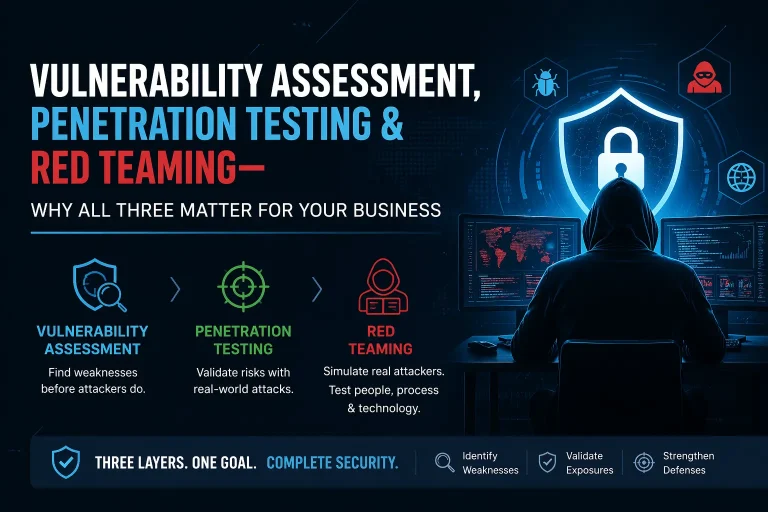
Why Your Business Needs SAST, DAST, IAST, VAPT, RASP, and HAST for Complete Security
Static Application Security Testing (SAST) examines code for vulnerabilities without executing it, aiding in early detection of issues like injection flaws of insecure configurations.
Dynamic Application Security Testing (DAST) assesses running applications by simulating attacks, identifying vulnerabilities like input validation errors or weak authentication.
Interactive Application Security Testing (IAST) combines SAST and DAST by monitoring code during runtime, providing real-time feedback on vulnerabilities and attack paths.
Vulnerability Assessment and Penetration Testing (VAPT) encompasses all these methods, each, including SAST, DAST, and IAST, offers unique benefits. SAST catches coding errors early in development, DAST uncovers runtime vulnerabilities, and IAST provides immediate insights during testing.
Utilizing these approaches ensures a security testing strategy, addressing issues at various stages of the development lifecycle for protection against security threats. As cyber threats evolve, organizations need tools to protect their software.

SAST: Catching Vulnerabilities at
the Source
What is SAST?
SAST examines an application’s source code, bytecode, or binary code without executing the program. It’s like proofreading a book before publication.
Why SAST is Needed:
- Early Detection: Identifies security flaws early in the development cycle
- Cost-Effective: Fixing issues in the coding stage is cheaper than post-deployment
- Compliance: Helps meet coding standards and regulatory requirements
Key SAST Tools:
Checkmarx: Checkmarx offers SAST solutions that scan source code for vulnerabilities in various programming languages.
Fortify Static Code Analyzer: Fortify provides SAST tools that analyze source code for security vulnerabilities and compliance with coding standards.
SonarQube: SonarQube is an open-source platform for continuous inspection of code quality and security vulnerabilities.
DAST: Testing Applications in Action
What is DAST?
DAST tests running applications by simulating attacks and analyzing responses. It’s akin to stress-testing a product in real-world conditions.
Why DAST is Needed:
- Real-World Scenarios: Identifies vulnerabilities that only appear during runtime
- External Perspective: Mimics how an attacker would approach your application
- Continuous Monitoring: Can be integrated into CI/CD pipelines for ongoing security
Key DAST Tools:
OWASP ZAP (Zed Attack Proxy): ZAP is an open-source tool for finding security vulnerabilities in web applications during the development and testing phases.
Burp Suite: Burp Suite is a platform for web application security testing, including DAST capabilities for identifying vulnerabilities.
Acunetix: Acunetix is a web vulnerability scanner that provides DAST capabilities for detecting security flaws in web applications.
VAPT Goes Beyond SAST and DAST
What is VAPT?
VAPT combines vulnerability assessment and penetration testing, providing a security evaluation.
Why VAPT is Needed:
- Holistic Approach: Covers both automated scanning and manual testing
- In-Depth Analysis: Identifies complex vulnerabilities that automated tools might miss
- Risk Assessment: Provides a clear picture of your overall security posture
When to Choose VAPT:
- For critical applications handling sensitive data
- When regulatory compliance requires thorough security audits
- Before major releases or infrastructure changes
SAST and DAST are crucial components of a security testing strategy, VAPT offers an approach for critical systems.
IAST (Interactive Application Security Testing)
IAST is like a mix of SAST and DAST. It watches the program while it’s running and checks its behavior in real-time for any problems.
Imagine having someone watch you cook and pointing out if you’re doing something wrong as you go along.
IAST combines elements of SAST and DAST by analyzing the application’s code while it’s running in a testing environment. It monitors the application’s behavior in real-time, identifying vulnerabilities and potential attack paths.Significance: IAST offers more accurate results compared to SAST and DAST alone. By analyzing the application’s code during runtime, it can detect vulnerabilities that may not be apparent in static or dynamic analysis.Tools:
Contrast Security: Contrast Security provides IAST solutions that continuously monitor applications for security vulnerabilities and provide real-time feedback to developers.
Veracode Interactive Analysis: Veracode offers IAST capabilities as part of its application security testing platform, allowing for the detection of vulnerabilities during runtime.
Why Needed:
- Real-time Monitoring: It provides real-time insights into the application’s behavior and detects vulnerabilities as the application runs.
- Contextual Analysis: Offers better context by combining code analysis with runtime data, leading to more accurate vulnerability detection.
Key Tools:
- Contrast Security
- Veracode IAST
- Synopsys Seeker
RASP (Runtime Application Self-Protection)
RASP is like having a security guard inside the program. It watches for any suspicious activity and stops attacks in real-time.
It’s like having a bodyguard who jumps in to protect you if someone tries to harm you.
RASP is a security technology integrated into an application or its runtime environment that detects and prevents attacks in real-time. It continuously monitors the application’s behavior and takes action to protect against security threats. Significance: RASP offers proactive protection by intercepting and blocking attacks at runtime. It can defend against a wide range of attacks, including injection attacks, cross-site scripting (XSS), and SQL injection Tools:
Sqreen: Sqreen provides RASP solutions that protect web applications from security threats by monitoring application behavior and applying security controls in real-time.
Contrast Protect: Contrast Security offers RASP capabilities that automatically detect and block attacks in real-time, providing continuous protection for applications.
Imperva RASP: Imperva RASP provides runtime protection for web applications by monitoring traffic, detecting attacks, and taking action to mitigate security risks.
Why Needed:
- Immediate Protection: Provides immediate threat detection and prevention at runtime, reducing the window of vulnerability.
- Context-Aware Defense: Uses contextual information from the application to accurately identify and mitigate threats.
Key Tools:
- Imperva RASP
- Signal Sciences (now part of Fastly)
- Sqreen (now part of Datadog)
HAST (Hybrid Application Security Testing)
HAST checks the computer where the program runs to make sure it’s safe. It looks for weaknesses in how the computer is set up.
It’s like checking your house to make sure all the doors and windows are locked to keep intruders out.
HAST focuses on assessing the security of the underlying infrastructure (host) on which an application runs. It involves evaluating the configuration, patch level, and security settings of the host environment to ensure it is properly secured.Significance: HAST is essential for ensuring the overall security of web applications. Weaknesses in the host environment, such as outdated software, misconfigurations, or unpatched vulnerabilities, can expose applications to security risks.Tools:
Nessus: Nessus is a vulnerability scanner that can assess the security posture of hosts by identifying vulnerabilities, misconfigurations, and other security issues.
OpenVAS (Open Vulnerability Assessment System): OpenVAS is an open-source vulnerability scanner that can scan hosts for security vulnerabilities and provide detailed reports on potential risks.
Why Needed:
- Comprehensive Coverage: Offers a broad range of testing techniques, covering more potential vulnerabilities.
- Balanced Approach: Utilizes both static and dynamic analysis for a thorough security evaluation.
Key Tools:
- Checkmarx
- Veracode
- Fortify
DAST is especially valuable for companies that:
Have frequently updated web applications
Need to test third-party integrations
Want to simulate real-world attack scenarios
VAPT is particularly important for companies that:
Handle highly sensitive data
Are subject to strict regulatory requirements (e.g., HIPAA, PCI DSS)
Have a large attack surface due to complex systems
Are high-value targets for cybercriminals
Need security audits for compliance or risk management.
SAST is particularly useful for companies that :
Have continuous integration/continuous deployment (CI/CD) pipelines
Need to comply with coding standards or regulations
Want to catch vulnerabilities early in the development process

Read: Simplify Your Success: Seamless Operations With EUC Management Solutions
Comparative Analysis
Immediate Defense: RASP stands out by offering real-time defense capabilities, unlike SAST and DAST, which focus on detection rather than prevention.
Detection Timing: SAST is used earlier in the SDLC, while DAST, IAST, and RASP are utilized later when the application is running.
Contextual Awareness: IAST and RASP provide more contextual awareness compared to SAST and DAST, leading to more accurate and fewer false positives.
Coverage: HAST provides the most coverage by integrating multiple testing methodologies.
Trust us for:
- Installation Support
- Timely Renewal
- Zero-Day Trust
- Learning Something New
Do you have a complete oversight of your Security Posture?
Unlock Insights by Scheduling Your Comprehensive Discovery Call Now