Penetration Testing as a Service (PTaaS) – Protecting the Business From World Cyber Risk
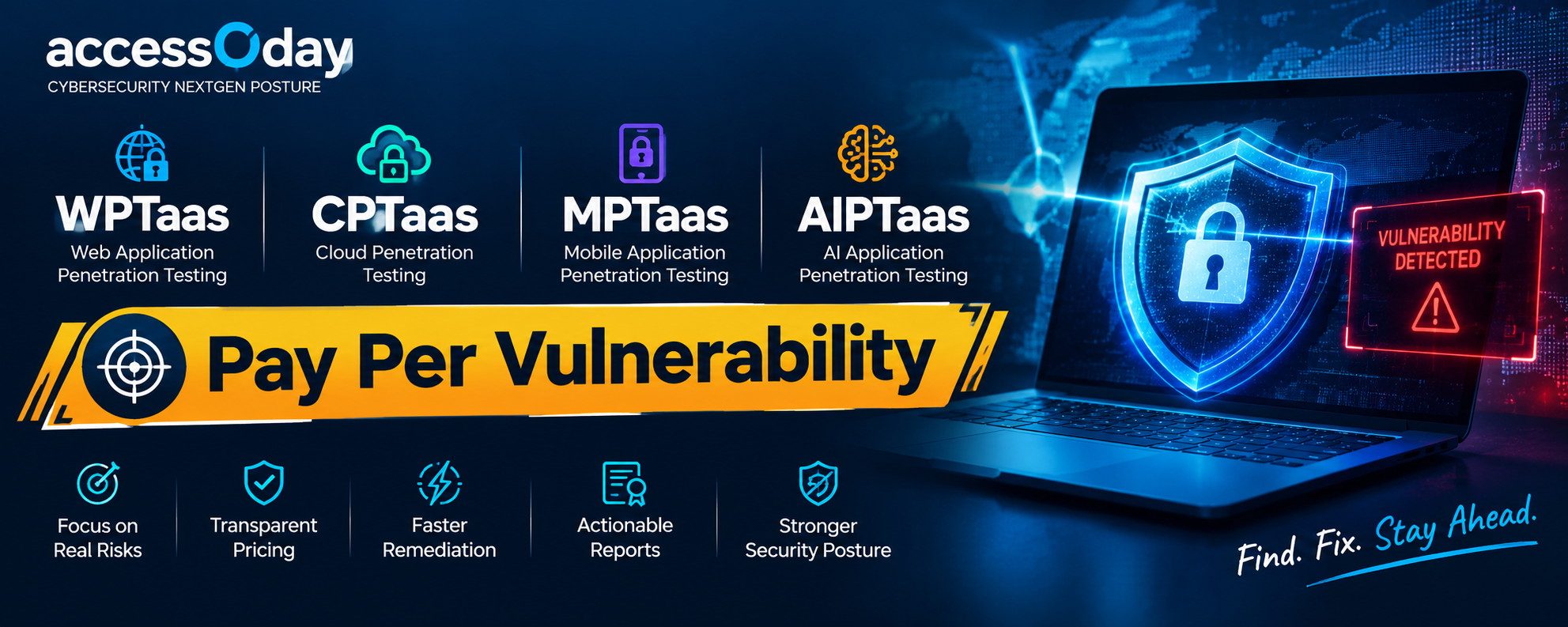
Penetration Testing as a Service (PTaaS) is designed to protect critical business systems—including web applications, cloud platforms, mobile applications, APIs, and emerging AI solutions—from real-world cyber threats.
Unlike traditional security testing that relies heavily on automated scans, our approach simulates real attacker behavior to uncover vulnerabilities that could impact business operations, sensitive data, and service availability. This enables organizations to identify hidden risks early and remediate them before they become serious incidents.
We help organizations reduce exploitable attack surfaces, validate remediation, improve security maturity, and strengthen cyber resilience through continuous testing.
Comprehensive PTaaS Coverage
Our PTaaS model includes specialized, continuous testing across key areas:
MPTaaS (Mobile Penetration Testing as a Service)
Security testing for mobile applications to uncover risks in data storage, API communication, authentication, and platform-specific vulnerabilities.
WPTaaS (Web Penetration Testing as a Service)
Continuous testing of web applications to identify vulnerabilities such as authentication flaws, injection attacks, and business logic weaknesses.
CPTaaS (Cloud Penetration Testing as a Service)
In-depth security assessment of cloud environments to detect misconfigurations, access control issues, and exposure risks across cloud infrastructure.
Secure Your Business – Get a Quote Now

Reduce cyber risk—not just pass audits

Stronger ROI Through Risk Reduction and Cost Predictability
From a business perspective, continuous security testing is an investment in risk reduction, operational resilience, and long-term value. Early detection of vulnerabilities lowers remediation costs, minimizes the likelihood of costly breaches, and reduces the risk of downtime or regulatory penalties. By offering predictable pricing, faster issue resolution, and clear risk metrics, PTaaS plans help organisations protect revenue, maintain customer trust, and make informed, confident decisions—delivering a measurable return on security investment.
Secure Digital Technology, Enable Growth
System stability, scalability, innovation without disruption
- Ensures applications, cloud platforms, APIs, and AI systems remain secure as the organization scales
- Identifies security weaknesses early, reducing unplanned outages and operational disruptions
- Supports faster digital transformation by validating security before and after releases
- Provides clear visibility into technology risk without slowing development teams
- Enables confident adoption of cloud and modern architectures with continuous assurance

Pay for the vulnerabilities we prove

Pay Per Vulnerability Penetration testing
Pay per vulnerability penetration testing is an outcome-based model. Instead of billing for researcher hours, access0day charges for the verified, exploitable vulnerabilities found in your environment. If we cannot demonstrate real impact with a working proof of exploit, it does not appear on your invoice.
Delivered as Penetration Testing as a Service (PTaaS), testing is continuous rather than a once-a-year snapshot, so new code, new features and new cloud changes are tested while they are new.
Why traditional penetration testing falls short
A conventional engagement is priced by the hour and paid in advance. The invoice is the same whether the team finds a critical data leak or nothing at all. Nobody in that arrangement is rewarded for the one result you care about.
01
The invoice ignores the result
A shallow test and a deep test cost the same, so depth depends on goodwill and on who is assigned.
02
The report becomes the goal
When the deliverable is a signed document for an audit deadline, both sides optimise for delivering it on time.
03
A snapshot of a moving target
Your teams ship every week. A test run once or twice a year says nothing about the feature released the day after it ended.
04
Scope is set by hours, not risk
Large APIs, cloud accounts and older systems often get a lighter look than they deserve because the days run out.
05
Quality depends on the tester
Two testers can read the same scope and produce very different results. You find out which one you had after you have paid.
06
Weeks of waiting, then a long PDF
A dangerous issue found early sits unfixed until the report arrives, and much of it is scanner output you still have to sort.
How pay per vulnerability PTaaS works
We earn our larger fees only when we prove a real, exploitable Medium, High or Critical issue in your environment. Going deeper on your assets is the only way we get paid more, so that is exactly what we do.
01
Scope and verify
You choose the assets to test. Ownership is verified with a DNS check, and we test nothing outside the agreed scope.
02
Continuous testing
Experts simulate real attacker behaviour, supported by tooling, on a schedule and on every release rather than once a year.
03
Proof of exploit
Every candidate issue is validated with a safe proof of concept. Only verified findings are billed, with evidence and reproduction steps.
04
Fix and free re-test
You receive fix guidance as findings are confirmed, then trigger a free re-test to confirm the fix is closed.
Traditional penetration testing vs pay per vulnerability PTaaS
| Question | Traditional pentest firm | access0day PTaaS |
|---|---|---|
| How is it priced? | Hours of researcher time, paid before work starts | Pay for verified Medium, High and Critical findings |
| If nothing is found? | Same invoice | Nothing billable, and a summary report on subscription |
| Who benefits from depth? | Nobody in particular; scope is fixed | Both of us: deeper testing finds more real issues |
| How often is it tested? | Once or twice a year | Continuous and on every release |
| What do you receive? | One long report at the end | Verified findings as confirmed, with proof and fix steps |
| Confirming a fix | Often a paid retest | Free re-test on demand |
| CI/CD fit | Separate project, separate calendar | Integrates with your pipeline, Jira and Slack |
Two ways to buy pay per vulnerability pentesting
Choose pay-per-vulnerability only for occasional testing, or add an annual subscription for continuous PTaaS. Your quote confirms the exact rates for the model you select.
| Pay-per-vulnerability only | Subscription + pay-per-vulnerability | |
|---|---|---|
| Subscription | None, no commitment | Annual subscription for the platform |
| Low findings | Chargeable | Included |
| Medium, High and Critical | Charged per verified finding | Charged per verified finding at lower plan rates |
| Scanning | On request | Continuous and on every release |
| CI/CD and ticketing | Not included | Included on higher plans |
| Summary report | On request | Included |
| Spend caps | Per engagement | Annual and monthly |
| Best for | Occasional tests and pre-launch checks | Teams that ship regularly or answer to customer audits |
How vulnerabilities are rated
| Severity | What it means | Typical examples |
|---|---|---|
| Low | Limited impact, hard to exploit | Verbose errors, missing security headers |
| Medium | Exploitable, limited blast radius | Stored XSS, CSRF on sensitive actions |
| High | Serious compromise of users or data | Authentication bypass, SQL injection, IDOR |
| Critical | Full takeover or mass data exposure | Remote code execution, secrets granting cloud admin |
Never charged in either model: duplicates, findings we cannot exploit, issues you have accepted as risk, and re-tests. A chain of smaller bugs that ends in one critical impact is billed once, as one Critical. You can dispute any severity within 10 days and a second reviewer re-rates it.
Black box, gray box and white box penetration testing
The difference is how much we know about your system before we start. More knowledge lets us test deeper and reach issues an outsider never could. Per-finding rates do not change with the approach; deeper access simply surfaces more of what matters.
Black box: we start like an outsider
- Knowledge: none, only public domains and IPs
- Finds: exposed services, public-facing flaws, weak logins, misconfigurations
- Limits: cannot see behind the login or inside the code
- Best for: a fast view of what the internet sees
Gray box: we start like a customer or insider
- Knowledge: partial, with test accounts, API docs and architecture notes
- Finds: broken access control, IDOR, privilege escalation, business-logic flaws
- Limits: may miss flaws visible only in source code
- Best for: most SaaS and API products
White box: we start with full visibility
- Knowledge: full, with read-only source code and cloud configuration
- Finds: hardcoded secrets, insecure code paths, attack paths from code to cloud
- Limits: needs more setup and access approval
- Best for: deepest coverage and strongest assurance
Vulnerability assessment vs. penetration testing: what matters to the business
Vulnerability assessments highlight potential weaknesses, but they do not show which issues can realistically hurt the business. Penetration testing focuses on what an attacker can actually exploit to cause financial loss, regulatory exposure or operational disruption. Many vulnerabilities exist in any environment, yet only a small number represent real business risk. Penetration testing helps leadership direct investment to the issues that matter most, which reduces wasted security spend and gives clearer control over risk and cost.

PTaaS for CIO, CTO and CISO
Security buying decisions are shared. Each leader needs a different answer, and pay-per-vulnerability PTaaS is designed to give all three.
CISO: are we measurably less exposed?
- Every billed finding is proven exploitable, not inferred
- Attack paths chained across application, API and cloud
- Published severity criteria with a 10-day dispute window
- Free re-tests confirm each fix is closed
- Summary evidence for auditors, customers and the board
CTO: will this slow my teams down?
- Testing runs continuously and on every release
- Findings arrive as confirmed, not weeks later in a PDF
- Reproduction steps and fix guidance developers can act on
- CI/CD, Jira and Slack integrations on higher plans
- No scanner noise to triage
CIO: can I predict and justify the spend?
- A predictable annual subscription option
- Annual and monthly caps on finding charges
- You pay for outcomes, not hours
- A clean year still produces evidence of what was tested
- Clear risk metrics for budget and board conversations
Guardrails every pay per vulnerability engagement includes
Pay-per-finding only works when customers can trust the process. These controls are built into every engagement.
01
Verified scope only
We test only assets you have proven you own, using a DNS check, and nothing outside the agreed scope.
02
Safe by design
Non-destructive proofs, rate limits and agreed testing windows. Anything that could affect availability is agreed with you first.
03
Proof on every charge
Reproduction steps, evidence and fix guidance for each billed finding, so your team can verify it independently.
04
Fair severity ratings
Published rating criteria based on demonstrated impact, a 10-day dispute window and a second reviewer.
05
Spend you control
Annual and monthly caps. Findings above the cap are still reported in full; billing pauses until you approve.
06
Evidence you can show
A summary of what was tested, when, and what was found and fixed, even in a year with no billable findings.
How to request a PTaaS quote
Pricing depends on the model you choose, the assets in scope and the testing approach, so every engagement is quoted individually. Getting a quote takes four simple steps.
STEP 1
Select Request a Quote
Use any Request a Quote button on this page to open our contact page and start the conversation.
STEP 2
Tell us what you run
Share the domains, web apps, APIs, mobile apps and cloud accounts you want tested, and your preferred model.
STEP 3
We confirm scope
We agree the testing approach (black, gray or white box), verify asset ownership and note any deadlines or compliance needs.
STEP 4
Receive your tailored quote
You get a clear quote for your environment, with spend caps and terms, ready to review with your team.
Pay per vulnerability pentesting FAQs
What is pay per vulnerability penetration testing?
Pay per vulnerability penetration testing is an outcome-based security testing model. Instead of paying for the hours a tester spends, you pay for the verified, exploitable vulnerabilities that are found in your environment. Every charge is backed by a working proof of exploit.
How is PTaaS different from a traditional penetration test?
Penetration Testing as a Service (PTaaS) tests your applications, APIs, cloud and mobile apps continuously and on every release, and delivers verified findings as they are confirmed. A traditional penetration test is a point-in-time engagement that ends with a single report.
Do I pay if no vulnerabilities are found?
With the pay-per-vulnerability only model you pay nothing when nothing billable is found. With the subscription model you pay only your subscription and still receive a summary report of what was tested, when, and what was found.
Which vulnerabilities are chargeable?
Verified, exploitable findings rated Medium, High or Critical are chargeable in both models. Low findings are chargeable in the pay-per-vulnerability only model and included in the subscription model. Duplicates, findings we cannot exploit, accepted risks and re-tests are never charged.
How much does pay per vulnerability pentesting cost?
Cost depends on the model you choose, the number and type of assets in scope, and the testing approach. Select Request a Quote and we will confirm scope and send a quote tailored to your environment.
What is the difference between black box, gray box and white box testing?
Black box testing starts with no knowledge, like an outsider. Gray box testing starts with test accounts and API documentation, like a customer or insider. White box testing starts with read-only access to source code and cloud configuration for the deepest coverage.
Is penetration testing safe for production systems?
Yes. We use non-destructive proofs and rate limits, test inside agreed windows, exclude any system you ask us to, and test only assets you have verified as yours.
Will a PTaaS report satisfy SOC 2, HIPAA or ISO 27001?
Our reports are designed to support audit evidence.
Start your pay per vulnerability PTaaS journey
Ready to uncover real-world vulnerabilities before attackers do? Request a quote for continuous, expert-led penetration testing and tell us whether pay-per-vulnerability only or subscription plus pay-per-vulnerability fits how you ship.
Talk to us Unparalleled ExpertiseCutting-Edge TechniquesTailored SolutionsProactive ApproachTrusted Partnership
Do you have a complete oversight of your Security Posture?
Unlock Insights by Scheduling Your Comprehensive Discovery Call Now
-
Why Your Business Needs SAST, DAST, IAST, VAPT, RASP, and HAST for Complete Security
Static Application Security Testing (SAST) examines code for vulnerabilities without executing it, aiding in early detection of issues…
-
Prevent Email Spoofing and Phishing with Email authentication protocols – DMARC, DKIM, SPF, and BIMI
The email authentication protocols, including DMARC, DKIM, SPF, and BIMI, are significant for several reasons, and their implementation…
-
The Advantages of Secure Access Service Edge (SASE) for Modern Enterprise Security
The internet and cloud have decentralized corporate assets and workforces, exposing organizations to new threats. Secure Access Service…